

Thinning Hair in Women During Menopause: Causes and Scientific Solutions
Menopause is a period of profound transformation, but for many women, it also brings unwanted changes. A thinner ponytail, a wider parting, or a noticeable loss of volume: thinning hair is one of the most confronting symptoms. You are not alone. This phenomenon is not a sign of failure, but a biological process that requires a targeted, scientific approach. Forget superficial solutions and discover how to tackle the root cause from within, to restore your hair's vitality and regain your self-confidence.
Why Your Hair Thins During Menopause: The Biological Cause
During menopause, your body undergoes a profound hormonal shift that directly impacts your hair's health. Understanding this process is the first step towards an effective solution.
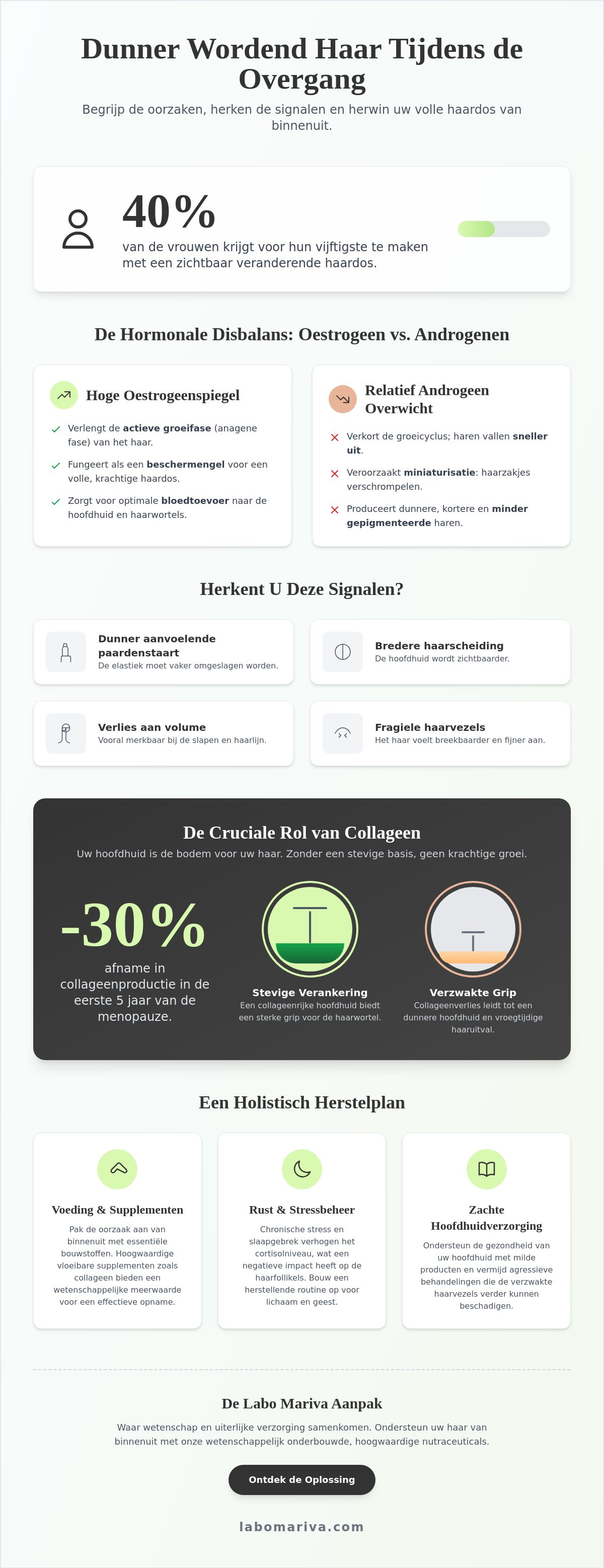
- Drastic drop in estrogen: This female hormone plays a crucial role in extending the anagen (growth) phase of your hair. A sharp drop shortens this phase, causing hair to fall out faster.
- Relative increase in androgens: When estrogen decreases, male hormones like testosterone gain relatively more influence. This can lead to the miniaturization of hair follicles, causing them to shrink and produce finer, weaker hairs.
- Recognizable symptoms: You often notice it by a thinner ponytail, more visible scalp at the parting, and less volume, mainly at the temples and top of the head.
- Temporary vs. permanent: It is essential to distinguish between temporary hair loss due to hormonal fluctuations and the permanent miniaturization of the hair follicle, which requires a structural approach.
The Impact of Estrogen Decline on the Hair Follicle
The decrease in estrogen is more than an abstract hormonal fact; it has concrete, physiological consequences for your scalp. Estrogen supports blood flow to the scalp, which is essential for supplying oxygen and nutrients to the hair follicles. When this supply diminishes, the hair roots literally receive less nourishment. This leads to a process of miniaturization: new hairs that grow back are thinner, shorter, and more brittle. The growth cycle becomes shorter and the resting phase longer, resulting in an overall loss of hair density. (biological cause of hair loss)
Hair Loss vs. Hair Thinning: An Essential Distinction
Although the terms are often used interchangeably, there is an important difference. Hair loss (telogen effluvium) is often a temporary, diffuse shedding across the entire scalp, where you suddenly find more hairs in your brush or shower drain. Hair thinning during menopause (androgenetic alopecia) is a slower process where not only the amount of hair decreases, but also the diameter of each individual hair fiber. If you are concerned, it is advisable to consult a doctor for a blood test to rule out deficiencies (such as ferritin) or thyroid problems.
The Forgotten Role of Collagen in Menopausal Hair Loss
While the focus is often on hormones, the foundation of healthy hair is often overlooked: the condition of the scalp. Your scalp is largely made up of collagen, the protein that provides structure, firmness, and elasticity. A healthy dermis is the literal breeding ground for strong hair roots.
- Collapse of production: After menopause, a woman's collagen production drops by almost 30% in the first five years.
- Weakened anchoring: A thinner, less resilient scalp provides less stability for the hair follicle. The hair root is less securely anchored, leading to premature shedding.
- Structural deficiency: Traditional supplements, such as vitamins or minerals like silicon, cannot perform optimally if the structural basis – the collagen matrix – is missing. They need a solid foundation to be effective.
Why Collagen is the "Soil" for Your Hair
Collagen type I and III are extremely important for maintaining the elasticity and firmness of the skin, including the scalp. In addition, hydrolyzed collagen provides specific amino acids such as proline and glycine. These are the direct building blocks for keratin, the protein that makes up more than 90% of your hair. Collagen also helps to neutralize free radicals, which can damage hair follicles and accelerate the aging process. (scientific solutions for hair loss)
Bioavailability: Why Shots Work Better Than Powders
Not all collagen supplements are created equal. Effectiveness is determined by bioavailability: the extent to which your body can absorb and use it. Molecular size (expressed in Daltons) is crucial here. Large molecules, as often found in powders, are difficult to absorb. Liquid, hydrolyzed collagen peptides in a shot have a much lower molecular weight, allowing them to be efficiently absorbed into the bloodstream and reach the dermis of the scalp faster. The Activate collagen boost is specifically formulated for maximum absorption and structural support from within.
Comparing Solutions: From Hair Transplants to Nutraceuticals
When faced with thinning hair, the range of solutions can be overwhelming. It's important to understand the different approaches to make an informed choice that suits your lifestyle and goals.
- Medical treatments: Options like Minoxidil and mesotherapy can be effective, but require long-term commitment and carry potential side effects.
- Cosmetic solutions: Thickening shampoos and serums coat the hair fiber, giving a temporary feeling of volume. However, they do not address the biological cause in the hair root.
- Nutraceuticals: This is the scientific middle ground. High-quality supplements restore biology from within by providing the right building blocks, without the side effects of medication.
- Cost-benefit analysis: Invasive procedures are costly and not without risk. A consistent course of the right nutraceuticals often offers the most sustainable and cost-effective results for the average woman in menopause.
Clinical Interventions Under Scrutiny
Mesotherapy and PRP (Platelet-Rich Plasma) inject nutrients or growth factors directly into the scalp to stimulate hair growth. This can be effective, but requires repeated and often painful sessions. Hormone replacement therapy (HRT) is rarely prescribed solely for hair growth due to its complex side effects. A hair transplant is a particularly invasive and expensive procedure that is only an option when sufficient donor hair is available and hair loss has stabilized. (Causes and scientific solutions)
The Power of Targeted Supplements
The most sustainable and elegant approach is to restore internal balance. A combination of high-quality hydrolyzed collagen and specific micronutrients tackles the problem at its root. Minerals such as silicon play a key role in keratin production and strengthening the hair fiber. When combined with a solid collagen base, a powerful synergy for structural recovery is created. It is crucial to understand that this is not a quick fix; hair needs time to complete its growth cycle. Visible results, such as new 'baby hairs' and more volume, are usually noticeable after 3 to 6 months of consistent daily use.
A Holistic Recovery Plan: Nutrition, Rest, and Scalp Care
Supplements are at the core of the solution, but their effect is enhanced by a lifestyle that supports recovery. Menopause is often a stressful period, and this has a direct impact on your hair.
- Manage cortisol: The stress hormone cortisol is an enemy of hair growth. It can prematurely force hairs from the growth phase to the resting phase, leading to increased shedding.
- Prioritize sleep: Cellular recovery takes place during deep sleep. This is when your body regenerates the cells in the hair follicles.
- Nourish your hair: Ensure a diet rich in proteins (the building blocks of hair), iron (for oxygen transport), and healthy fats (for shiny hair).
- Be gentle: Avoid aggressive chemical treatments, excessive heat from styling tools, and tight hairstyles that pull at the hair roots. Your hair is now more fragile and deserves gentle care.
In addition to external hair care, it is essential to pay attention to your overall intimate balance, which often requires extra attention during this stage of life. For those seeking targeted solutions, exploring specialized products such as boric acid suppositories South Africa can offer valuable insight into maintaining a healthy and confident feeling.
Stress Management and Its Impact on Hair Loss
Chronic stress during menopause can exacerbate hormonal imbalance and block hair growth. Finding moments of rest is not a luxury, but a necessity for both your mental well-being and the health of your hair. A calm mind creates the right biochemical environment for recovery. The Unwind gummies are designed to help manage cortisol levels and promote deep, restorative sleep.
Optimal Nutrition for Menopausal Hair
Women in menopause often have an increased need for specific minerals. Zinc and selenium are essential for hair growth and scalp health. Antioxidants, found in berries, leafy greens, and nuts, help protect hair follicles from oxidative stress. Start your day with a hair-healthy breakfast, such as Greek yogurt with nuts and seeds, to directly provide your body with the right building blocks.
The Labo Mariva Approach: Where Science Meets Beauty
At Labo Mariva, we believe not in empty promises, but in scientific evidence and visible results. Our approach combines pharmaceutical expertise with a deep understanding of the aesthetic and emotional needs of women in menopause.
- Expertise and passion: We translate complex biochemistry into elegant, effective solutions for your well-being.
- Activate: Our liquid collagen formula is superior for menopausal women due to its exceptionally high bioavailability and precise dosage of active ingredients.
- The power of synergy: The Combi Pack of Activate and Unwind offers a total solution: it restores the structural basis from within while you find the rest your body needs to regenerate.
- Made in Belgium: We guarantee the highest standards of purity, scientific validation, and high-quality, European ingredients.
Why Activate Sets the Standard
Activate is more than just a collagen supplement. The specific selection of hydrolyzed collagen with an optimized molecular weight guarantees maximum absorption. The formula is designed not only to strengthen your hair but also to improve the firmness and hydration of your skin and harden your nails. Women who follow a course report not only fuller hair but also a general improvement in their appearance and vitality.
Your New Ritual for Self-Confidence
Integrating Labo Mariva into your day is simple and feels like a moment of pure self-care. A shot of Activate in the morning for structural buildup and two Unwind gummies in the evening for profound recovery. This ritual is a statement: you take control of your own aging process. It is a conscious choice for vitality and grace. For a complete recovery plan, discover the scientific guide to sleep gummies and the impact of rest on your beauty.
Frequently Asked Questions
Below we answer some of the most frequently asked questions about thinning hair during menopause.
Is hair loss during menopause permanent?
Not necessarily. Hair loss due to hormonal fluctuations can often be slowed down and partly reversed with the right approach. When hair follicles are nourished with the correct building blocks (such as collagen) and underlying stress factors are managed, hair quality can significantly improve. Early intervention is crucial to stop the miniaturization of the follicles.
Which vitamins are most important for thinning hair during menopause?
While a wide range of vitamins is important, zinc, selenium, vitamin D, and B vitamins are particularly relevant. However, without the structural basis of proteins like collagen and keratin, vitamins alone cannot solve the problem. It is the synergy between building blocks, vitamins, and minerals that makes the difference.
How long does it take to see results from collagen shots?
The hair growth cycle is a slow process. The first results, such as stronger nails and more hydrated skin, can be noticeable within 4 to 8 weeks. For hair, it takes longer. Most women see a clear improvement after 3 to 6 months of consistent daily use, such as less hair loss, more shine, and the growth of new, short hairs along the hairline.
Can stress during menopause cause additional hair loss?
Absolutely. Stress increases cortisol levels in the body, which can push hair follicles into a premature resting phase (telogen effluvium). During menopause, you are extra susceptible to this. Effective stress management and improving sleep quality are therefore essential components of any successful hair loss prevention plan.
How do silicon and collagen work together for stronger hair?
Collagen and silicon have a wonderful synergy. Think of collagen as the 'foundation' of your scalp; it provides a firm and healthy dermis in which the hair roots are anchored. Silicon can be seen as the 'architect' that helps build the hair fiber itself. It is a crucial mineral for keratin production. Without a solid collagen foundation, silicon has no stable base to build on.
Does a shorter haircut help with thinning hair?
A shorter haircut does not stop hair loss, but it can have an optical effect. Shorter hair is lighter, making it less likely to be flattened by gravity. This can create the illusion of more volume. Moreover, a good cut can draw attention to your strengths and away from thinner areas.
Are there side effects associated with hair loss supplements?
High-quality nutraceuticals such as hydrolyzed collagen are generally very safe and have no known serious side effects. They are considered food supplements. However, it is always advisable to consult your doctor before starting any new supplement regimen if you have any medical conditions or are taking medication.