

Effectiveness of collagen supplements: what does the science really say?
In the world of beauty and wellness, few supplements are as ubiquitous as collagen. The promises are tempting: smoother skin, stronger nails, and lustrous hair. But with an abundance of powders, pills, and drinks, a crucial question arises for the conscious consumer: do those expensive collagen supplements really work, or is it clever marketing for wasted money? The answer lies not in the promises on the packaging, but in the biochemical reality of molecular size, absorbability, and biological activity.
The effectiveness of collagen supplements is not a matter of 'yes' or 'no', but of 'how'. This article delves deeper than the surface, providing you with the scientific tools to assess the quality and potential efficacy of a supplement yourself.
Table of Contents
-
What is collagen and why does the effectiveness of your body's own production decline?
-
The science behind the effectiveness of collagen supplements
-
Liquid collagen versus powder: what does the data say about absorption?
-
What to look for when buying an effective collagen supplement?
-
The Labo Mariva approach: why science and luxury go hand in hand
What is collagen and why does the effectiveness of your body's own production decline?
Collagen is the most abundant protein in our body and serves as the fundamental building block for our skin, bones, tendons, and connective tissue. In the dermis, the second layer of skin, it forms a strong network that provides structure, resilience, and hydration. It is literally the glue that holds our body together.
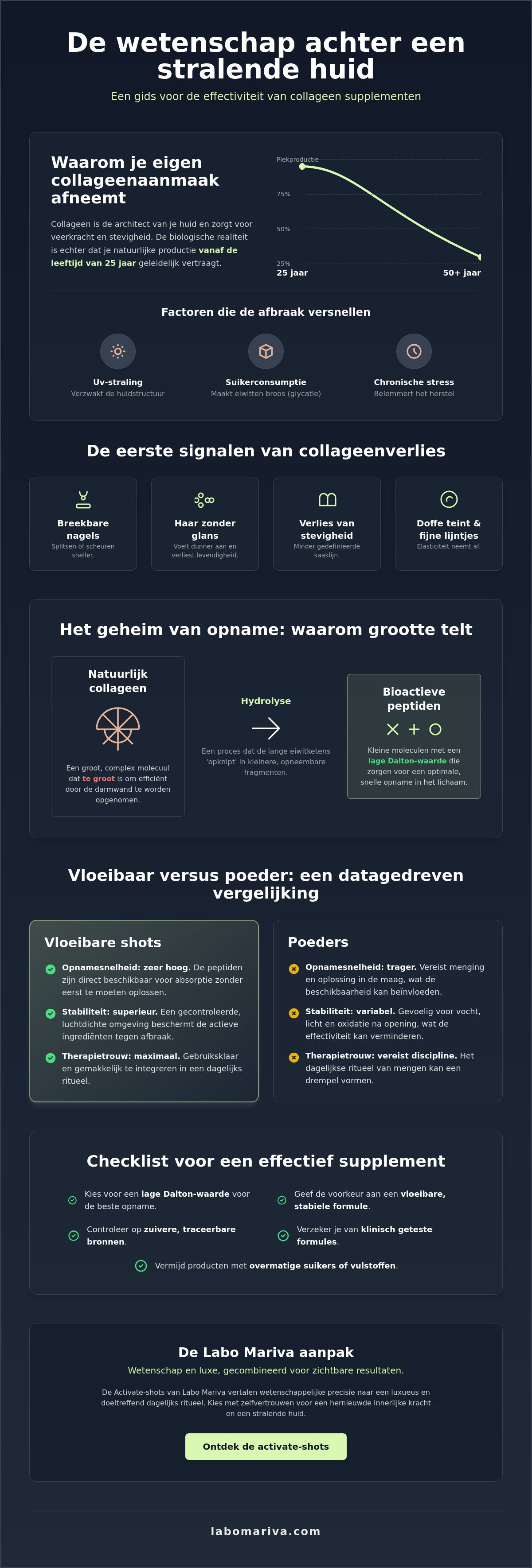
The biological reality, however, is that our natural collagen production inevitably decreases. From the age of about 25, production declines by approximately 1% per year. This process is further accelerated by external factors such as exposure to UV radiation, excessive sugar consumption, smoking, and chronic stress. Traditional skincare, such as creams and serums, primarily works on the epidermis and often cannot reach or activate the deeper-lying fibroblasts, the cells that produce collagen.
The role of fibroblasts in skin structure
Fibroblasts are the 'factories' in our skin responsible for producing new collagen and elastin. As we age, these cells become less active. To stimulate them again, they need specific triggers in the form of the right building blocks. There is a fundamental difference between protecting existing collagen and actively regenerating new collagen. Effective supplements focus on the latter: stimulating fibroblasts to restart production.
Symptoms of collagen loss in adults
The loss of collagen manifests itself in various ways. The skin loses its elasticity, leading to the formation of fine lines and wrinkles. Nails become more brittle, and hair can lose its shine and volume. Often, a dull, less vibrant complexion is one of the first visible signs of reduced collagen structure in the skin.
The science behind the effectiveness of collagen supplements
A common objection is that collagen is broken down into individual amino acids in the stomach, just like any other protein. This is true for unprocessed collagen. However, the effectiveness of modern supplements lies in a process called hydrolysis. Here, the large collagen molecule is 'cut' into much smaller, specific chains of amino acids: bioactive collagen peptides.
These peptides are small enough to largely survive digestion and be absorbed into the bloodstream through the intestinal wall. Their effectiveness is strongly determined by their molecular weight, expressed in Daltons (Da). The lower the Dalton value, the better the absorption and bioavailability. Scientific studies show that these specific peptides not only serve as building blocks but also as signaling molecules that stimulate fibroblasts to increase the production of the body's own collagen.
Hydrolyzed collagen and bioactive peptides
Bioactive peptides act as messengers. They signal to the body that collagen breakdown is occurring, which prompts fibroblasts to act. Although collagen can come from various sources, such as fish (marine) or poultry, bovine collagen is often chosen. This type is particularly rich in type I and III collagen, the most common types in human skin, contributing to targeted and effective action for skin firmness and elasticity. For optimal synthesis, synergy with vitamin C is crucial, as this co-enzyme is indispensable in the collagen production process.
The journey from ingestion to the dermis
After ingestion, the small peptides pass through the intestinal wall and are distributed via the bloodstream to the deeper skin layers throughout the body. Once there, they can do their work. To achieve a cumulative and noticeable effect, consistent, daily intake is essential. It is a process that works from within and takes time to produce visible results.
Liquid collagen versus powder: what does the data say about absorption?
The form in which collagen is offered directly impacts its effectiveness. Liquid supplements, often in the form of shots, generally offer higher bioavailability than powders, tablets, or capsules.
A liquid formulation ensures that the active peptides are homogeneously mixed and stabilized, which promotes absorption in the body. Moreover, the ease of use of a daily shot is significantly higher, which improves adherence. Powders must be dissolved and can clump, which can affect exact dosing and absorption. Additionally, liquid nutraceuticals often contain a higher concentration of active ingredients per serving and are purer, without unnecessary fillers.
Why bioavailability is key
Bioavailability refers to the extent and rate at which an active substance reaches the bloodstream. A superior formulation, such as that in a liquid shot, ensures that a larger percentage of peptides remain intact and are effectively absorbed. This maximizes the impact on the skin. More information on this crucial aspect can be found in our guide on collagen with high bioavailability.
The disadvantages of tablets and capsules
Tablets and capsules have clear limitations. The capacity of a capsule is limited, often requiring multiple per day to achieve an effective dose. Additionally, they must first disintegrate in the stomach, which delays the release process and exposes the peptides to stomach acid for longer. In clinical settings, liquid shots like Activate are often preferred, as they guarantee fast and efficient absorption.
What to look for when buying an effective collagen supplement?
Not all collagen supplements are created equal. To make an informed choice, it is important to look beyond marketing claims. Use the following checklist as a guide:
-
The source and type: Check the source of the collagen (e.g., bovine) and whether it contains hydrolyzed peptides specifically targeting the skin (type I and III).
-
Molecular weight: Look for information on the Dalton value. A lower value (ideally below 2,000 Da) indicates better absorbability.
-
Clinical evidence: Are there studies supporting the effectiveness of the specific peptides in the product?
-
Supportive nutrients: The presence of vitamin C is essential. Additional ingredients such as hyaluronic acid, silicon, or antioxidants can enhance the effect.
-
Purity: Avoid products with unnecessary sugars, artificial flavors, and colorants that can actually harm the skin.
For a detailed overview, please read our article on what to look for when buying collagen supplements.
A holistic view of skin improvement
True beauty comes from within and is supported by a healthy lifestyle. The effectiveness of a collagen supplement is enhanced by good sleep. During sleep, skin repair and regeneration occur. A supplement that supports sleep quality, such as Unwind, lays the foundation for optimal collagen synthesis and radiant skin upon waking.
The Belgian quality standard in nutraceuticals
Choosing a product of Belgian origin, developed according to pharmaceutical standards, offers additional assurance. Purchasing through a pharmacy, beauty institute, or specialized lab often guarantees higher quality and better guidance. Look for transparent ingredient lists and clear scientific evidence, characteristics of high-quality supplements.
The Labo Mariva approach: why science and luxury go hand in hand
At Labo Mariva, we believe not in empty promises, but in scientific precision. Our vision is based on the principle that outer beauty is a reflection of inner vitality. Therefore, we approach skincare from within, with formulas developed for maximum effectiveness.
Our supplement Activate is more than just a collagen drink. It is a concentrated shot with a high dose of bioactive bovine collagen peptides, carefully selected for their low molecular weight and proven efficacy. The daily ritual of an Activate shot is a moment of self-care, designed to activate your fibroblasts and provide your skin with the building blocks it needs to glow.
Scientific precision in every shot
Every Activate shot is the result of thorough research. We focus on a formula with exceptionally high bioavailability, so you can be sure that the active ingredients reach their destination. The result is an effect that goes beyond the surface, for skin that not only looks smoother but is also structurally healthier and more resilient.
Your journey to a radiant appearance
Consistency is key to success. After 28 days, the duration of a complete skin cycle, you can expect the first improvements in hydration and elasticity. For a comprehensive approach that includes both daily activation and nocturnal recovery, the Combi Pack offers the perfect synergy. Choose Belgian expertise and take control of your aging process. Your radiant skin starts today.
Frequently asked questions about the effectiveness of collagen
Is the effectiveness of collagen supplements scientifically proven?
Yes, numerous clinical studies have shown that the intake of specific, hydrolyzed collagen peptides can improve skin hydration, elasticity, and density, and reduce the visibility of wrinkles.
How long does it take to see results from collagen shots?
While individual results may vary, most users notice the first improvements after 4 to 8 weeks of consistent daily use. Optimal results are often seen after 3 months.
Isn't collagen just broken down by my stomach acid?
Unprocessed collagen is, but the hydrolyzed bioactive peptides in high-quality supplements are small enough to survive stomach passage and be absorbed into the bloodstream through the intestines.
What is the difference between marine collagen and bovine collagen?
Both are effective, but bovine collagen is particularly rich in type I and type III collagen. These are the two most common types in human skin, making bovine collagen a very suitable source for supplements aimed at skin improvement.
From what age is it beneficial to start with collagen?
Since natural production begins to decline around the age of 25, it makes sense to start preventatively from that point. From age 30, it often becomes a corrective addition to the daily routine.
Can I combine collagen supplements with other vitamins?
Absolutely. Collagen works excellently with other supplements. The combination with vitamin C is even essential for proper functioning. Activate is a 6-in-1 shot that already combines several supplements such as Silicon, Hyaluronic Acid, and SOD, which further enhance the benefits.
Are there any known side effects from using collagen peptides?
Collagen peptides are generally very safe and well-tolerated. Side effects are rare and mild, and may sometimes include slight bloating at the start of use.
Why are liquid supplements often more expensive than powders?
The production costs of a stable, pure, and highly concentrated liquid formula are higher. The price often reflects superior bioavailability, ease of use, and a higher dosage of active ingredients per serving.