

Hydrolyzed collagen: mechanism, absorption, and scientific evidence
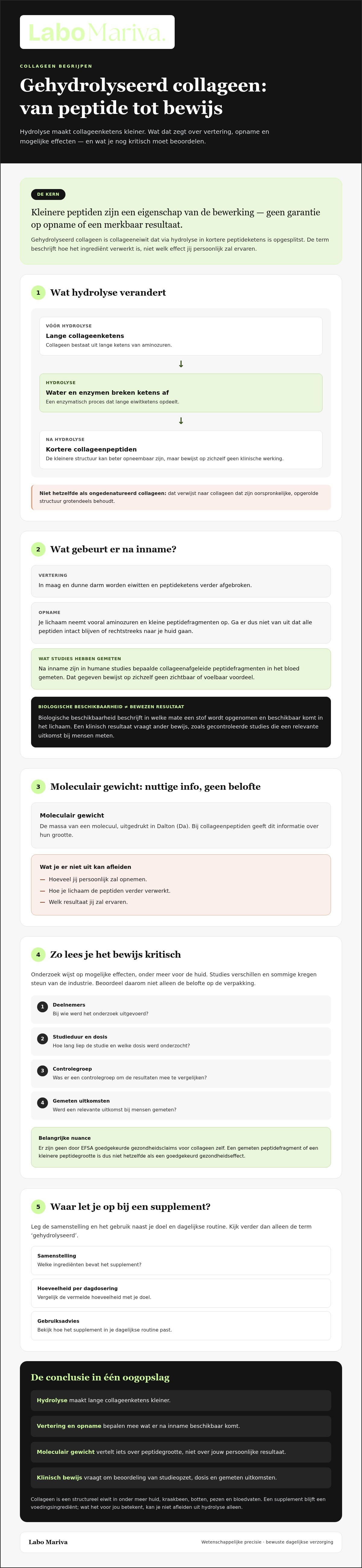
What happens to collagen after you ingest it, and does better absorbability also mean that the supplement does what the packaging promises? The mechanism of hydrolyzed collagen begins with hydrolysis: long collagen chains are broken down into smaller peptides. This makes them more absorbable, but in itself, it does not yet say how much effect you should expect.
It is understandable that you might be in doubt between scientific results and convincing marketing. Research into collagen peptides points to potential effects, including for the skin, but studies vary and some have received industry support. Moreover, there are no EFSA-approved health claims for collagen itself. A critical look at evidence, dosage, and composition is therefore important.
In this article, you will discover what exactly hydrolysis does, how your body processes collagen peptides, and what clinical research does and does not demonstrate. We also look at the role that dosage and daily use play, how you assess claims regarding supporting nutrients, and what to pay attention to when choosing a supplement. This way, you can determine with realistic expectations whether collagen fits your routine for inner health and outer care.
Key Takeaways
- Hydrolysis breaks long collagen chains down into smaller peptides, but this in itself does not prove that a supplement works clinically.
- Understand the mechanism of hydrolyzed collagen by also looking at digestion and absorption: not all peptides reach your body intact.
- Use the molecular weight as information about peptide size, not as a guarantee for individual absorption or results.
- Assess studies based on participants, study duration, dosage, control group, and measured outcomes to better estimate claims.
- Compare composition, quantity per daily dosage, and usage instructions with your goal and daily routine before choosing a supplement.
What is hydrolyzed collagen and what does its mechanism mean?
Hydrolyzed collagen is collagen that has been split into smaller peptide chains via hydrolysis. Hydrolysis is an enzymatic process in which long protein chains are broken down. This creates an ingredient that you find in certain dietary supplements. The term therefore describes how the collagen has been processed, not what effect you will personally experience.
Hydrolyzed collagen is collagen protein that has been broken down by hydrolysis into shorter peptides; this processing changes the shape of the ingredient, but does not guarantee absorption or a clinical result.
How does hydrolysis work for collagen?
Collagen consists of long chains of amino acids. During hydrolysis, those chains are divided into shorter pieces with the help of water and enzymes: collagen peptides. This smaller structure is different from that of intact collagen, but it does not mean that every peptide passes through your digestion unchanged or is fully absorbed.
Also, do not confuse hydrolyzed collagen with undenatured collagen. The latter refers to collagen that largely retains its original, coiled structure. Hydrolysis actually breaks that structure down further into shorter chains. They are therefore different forms and are not described in the same way.
Where is collagen found in the body?
Collagen is a structural protein in connective tissue. The various collagen types contribute to the structure of, among other things, skin, cartilage, bones, tendons, and blood vessels. This distribution is described in the overview by Ricard-Blum in Cold Spring Harbor Perspectives in Biology, a scientific discussion of the collagen family. For an initial explanation of the structure and types, you can also read: What is collagen.
The fact that collagen occurs naturally in your body does not make a supplement the same as the body's own collagen. A supplement provides collagen as a food ingredient; what happens to it after ingestion depends partly on digestion and absorption. The words hydrolyzed collagen mechanism therefore refer first to peptide formation. In themselves, they are not proof that a product noticeably changes your skin, joints, or other tissue.
So, see collagen as one part of a broader view of inner support and outer care. Read more about this coherence in the guide on beauty from within.
What happens to collagen peptides after ingestion?
After ingesting hydrolyzed collagen, digestion begins. Proteins and peptide chains are further broken down in the stomach and small intestine. Your body mainly absorbs amino acids and small peptide fragments. It is therefore not correct to assume that all collagen peptides pass through your digestion intact and are transported directly to, for example, your skin.
What role do collagen peptides and amino acids play?
The absorbed amino acids can be used by the body as building blocks for various proteins. In addition, certain collagen-derived peptide fragments have been measured in the blood in human studies after the ingestion of collagen hydrolysate. Iwai and colleagues reported this in a 2005 study in the Journal of Agricultural and Food Chemistry. The fact that such fragments are found in the blood does not in itself prove that they provide a visible or perceptible benefit.
Human studies show that some collagen-derived peptide fragments can be present in the blood after ingestion, but that is no guarantee of a perceptible clinical effect. Bioavailability describes the extent to which a substance is absorbed and becomes available in the body. A proven result requires other evidence, such as controlled studies that measure a relevant outcome in humans. The Harvard explanation of collagen supplements also puts the absorption and research into supplements into perspective.
What does molecular weight say about bioavailability?
The molecular weight is the mass of a molecule, expressed in Dalton (Da). With collagen peptides, this value provides information about their size. Smaller peptides may have different properties than larger ones, but peptide size is only one aspect of a supplement. It does not by itself tell how much a certain person will absorb, how the body processes the peptides, or what result that person will experience.
The full mechanism of hydrolyzed collagen therefore does not depend on a single number on the label. Also look at the quantity per daily dosage, the composition, the usage instructions, and the quality of the evidence for the specific formula. A liquid form does not automatically make a supplement more absorbable by itself. If you want to check a concrete label, consult the information on liquid collagen shots and carefully assess the product details mentioned.
Does hydrolyzed collagen really work? How to assess the evidence
Hydrolysis makes collagen smaller, but it does not prove that a supplement has a clinical effect. For the question of whether the hydrolyzed collagen mechanism is relevant, you have to look at studies with humans and at what those studies measure exactly. A mechanism that seems plausible in a laboratory is not yet a proven benefit for your skin or joints.
Which health outcomes did studies investigate?
Researchers have investigated collagen peptides for, among other things, skin outcomes such as hydration, elasticity, and wrinkles. A 2025 meta-analysis in the American Journal of Medicine compiled 23 randomized studies with a total of 1,474 participants and reported effects on the skin. That is relevant evidence, but no guarantee that everyone will notice the same thing. The authors of a meta-analysis combine results from existing studies; the quality of their conclusion therefore also depends on the quality of those studies.
A 2021 meta-analysis also found improvements in skin hydration, elasticity, and wrinkles compared to placebo. At the same time, the authors and reviewers pointed to limitations, including potential industry sponsorship. Moreover, skin results do not automatically say anything about joints. Assess studies on joint complaints separately, with their own participants, measurement methods, and outcomes. None of these findings proves a cure or a guaranteed improvement for you.
A 2025 meta-analysis in the American Journal of Medicine compiled 23 randomized studies with 1,474 participants and reported effects of collagen peptides on skin outcomes, but the results do not guarantee an individual benefit.
Why do research results differ from each other?
Studies do not always test the same supplement. The collagen source, the peptide profile, and the daily dose can differ, as can the study duration and the control group. The measurement method also counts: an instrumental measurement of skin hydration is not the same as a change that participants perceive themselves. As a result, a statistical difference can exist without it being clear how perceptible or meaningful that difference is in daily life.
Use these questions when reading a study:
- Who participated? Look at the number of participants and their characteristics.
- What did they get? Check the dose, collagen source, and any other ingredients.
- How was the study set up? Look for randomization, blinding, and an appropriate control group.
- What was measured, and for how long? A result applies to the investigated outcome and period, not automatically to other goals.
Also keep three levels apart: a proposed biological mechanism, a statistical difference in a study, and a meaningful result for you. That distinction makes claims about collagen supplements easier to assess and keeps expectations realistic.
How do you choose a collagen supplement based on mechanism?
A thoughtful choice does not start with a promise on the front, but with what you can verify. The term “hydrolyzed” tells you that collagen has been processed into smaller peptides. It does not prove that the supplement provides a certain result. Therefore, assess the hydrolyzed collagen mechanism based on the label and the research that supports any claims.
Which information on the label deserves attention?
Go through the label step by step. This way, you can compare products based on concrete information instead of loose marketing terms:
- Quantity: is the amount of collagen per recommended daily dosage clearly stated? Compare that with the dose that has been investigated in relevant studies.
- Form and source: read whether it concerns hydrolyzed collagen peptides and whether the collagen source is described. Also check whether the peptide form is explained clearly enough.
- Other ingredients: check which substances have been added and in what quantity. An ingredient on the list says nothing in itself about the working of the complete formula.
- Substantiation: does the investigated product correspond to the supplement on the label? Differences in dose, composition, or peptide profile limit how directly you can apply study results.
Also distinguish between evidence for collagen and permitted claims for other ingredients. According to European claim regulations, there are no approved EFSA health claims for collagen itself. A claim about an added nutrient is not automatically evidence that collagen has the same effect.
How do you use collagen with realistic expectations?
Follow the usage instructions on the label and do not increase the recommended amount based on general advice or a study with a different formula. Research can provide direction but is not a personal dosage schedule. Daily use makes it easier to maintain a routine; it does not guarantee a result. Factors such as diet, UV exposure, and smoking also play a role in the broader context of skin and connective tissue health.
So, give your choice time and assess it soberly. Note your goal, if necessary, and check after an agreed period whether you notice anything, without filling in an effect in advance. If you have questions due to a medical condition, medication, or a possible allergy, discuss the supplement with a healthcare professional first.
Do you want to assess a concrete collagen supplement? View the product information about collagen and test the composition and daily dosage against your needs and the available evidence.
Hydrolyzed collagen in your daily routine: a conscious choice
Hydrolysis explains how long collagen chains are broken down into smaller peptides. It does not tell you if your body absorbs them to a certain extent or that you will experience a visible or perceptible effect. So, use the term as information about the form of the ingredient, not as proof of a result. The hydrolyzed collagen mechanism also does not depend solely on the processing but must be assessed in research regarding the specific formula.
Before you choose, take a moment for this final check:
- Goal: determine which outcome you find important, for example, a skin-related outcome. Results for the skin do not automatically apply to joints or other goals.
- Label: check the collagen source, the form, the quantity per daily dosage, and all added ingredients.
- Substantiation: check whether studies involve a comparable composition, dose, and duration of use. A general claim is no substitute for appropriate evidence.
- Daily feasibility: choose a form and usage instruction that you can fit into your routine, without exceeding the recommended dosage.
Does a liquid collagen supplement fit your routine?
A liquid supplement can be practical if that form is easier for you to take. That ease of use is a personal preference, not proof of better absorption or mechanism. Labo Mariva offers Activate (28 shots) as a possible collagen option. Check the current product information before you choose, so that you know the composition, quantity, and usage instructions. Do not fill in unknown details yourself based on general claims about liquid collagen products.
A supplement does not replace a varied diet and is no alternative to professional care. If you have questions about your health, medication, or allergies, it is best to discuss the use with a healthcare professional. Even a daily routine cannot guarantee an individual effect; it does help you to keep the use consistent according to the label.
Which follow-up step helps you make an informed choice?
Quietly lay product information next to the evidence on which the claims are based. EFSA does not approve or certify a specific collagen supplement. There are no EFSA-approved health claims for collagen itself. For certain added nutrients, approved claims may apply if the product meets the conditions, but those claims are not evidence for a mechanism of collagen.
Do you want to check the composition and usage information yourself? View the product information about liquid collagen shots and test it against your goal and daily routine.
Choose consciously and make space for a fixed routine
Hydrolysis explains how collagen is broken down into smaller peptides. It does not prove that a supplement is absorbed by everyone or provides a perceptible effect. Therefore, assess the hydrolyzed collagen mechanism on the basis of human studies, the investigated dose and outcome, and the composition of the product.
When making your choice, look for a clear label, a transparent daily dosage, and usage advice that is feasible in your daily routine. Do not expect an immediate change and do not consider collagen as a replacement for a varied diet. EFSA has not approved any health claims for collagen itself; claims for added nutrients require a separate, correct assessment.
Labo Mariva lists Activate (28 shots) as a collagen option. Check the current composition and dosage on the product information. EU production is mentioned as a strong point, but verify whether that specifically applies to this product. Do you want to check the information yourself at your own pace? View the collagen options from Labo Mariva.
With a critical eye and realistic expectations, you make self-care a conscious choice that suits you.
Frequently asked questions about hydrolyzed collagen
What is hydrolyzed collagen?
Hydrolyzed collagen is collagen that has been broken down into smaller peptide chains via hydrolysis. This term describes the processing form of the ingredient, not a proven effect of a supplement in itself. Furthermore, collagen in a supplement is not the same as the collagen your body produces itself and uses in connective tissue. The potential efficacy of a supplement should be assessed based on research on humans and the specific formula.
How does hydrolyzed collagen work after ingestion?
After ingestion, collagen is digested into smaller peptide fragments and amino acids, which may be involved in absorption. You should not assume that all peptides travel intact to a target tissue. Some human studies have measured collagen-derived peptide fragments in the blood after ingestion, but their presence does not prove a clinical benefit. Therefore, for insight into how hydrolyzed collagen works, look at studies on humans that measure relevant outcomes.
Is hydrolyzed collagen absorbed better than regular collagen?
Hydrolysis yields smaller peptide chains and can be relevant for the digestion and absorption of collagen. This does not automatically mean that you will get a more visible or noticeable result than with another form of collagen. The source, composition, dose, and researched outcome all play a role. Therefore, compare product claims with studies on a formula with a comparable composition and dosage, rather than relying solely on terms like “smaller peptides.”
How much hydrolyzed collagen should you take per day?
There is no universal daily dosage that applies to every product and every user. Amounts differ between supplements and clinical studies, which do not always examine the same collagen source, formula, or outcome. Follow the usage instructions on the label and compare the daily dosage with research on a similar formula. Do not simply take more based on general advice. If you have personal health questions or are unsure about use, seek advice from a healthcare professional.
How long does it take for hydrolyzed collagen to work?
There is no set timeframe within which you can expect results. Studies use varying study durations, dosages, and measurement methods. A difference measured after a certain period therefore applies to that study and is not a promise for you. Consistent use can help maintain a routine, but does not guarantee an effect. Your starting situation, lifestyle, and the outcome you are monitoring influence how you can interpret research results and personal changes.
Is hydrolyzed collagen safe to use daily?
Follow the instructions on the label of the specific product; a general safety claim does not automatically apply to every formula or user. Check the ingredients and recommended usage instructions. In the case of allergies, medication, pregnancy, breastfeeding, or existing health concerns, personal advice is recommended. Discuss the use with a doctor, pharmacist, or other healthcare professional who knows your situation. Do not exceed the recommended amount based on general information about collagen supplements.
What is the difference between hydrolyzed collagen and collagen peptides?
Collagen peptides are the smaller peptide chains that are formed when collagen is broken down via hydrolysis. The terms are often used for related supplement forms, but they do not automatically tell you everything about the contents of a product. Source, composition, and quantity can vary. Therefore, check the label to see which form and daily dosage are actually listed. The name “collagen peptides” alone does not indicate how much you are taking or what result you can expect.