

How to deal with stress without therapy? Practical steps for more peace of mind
Trying to relax more doesn't always help when your mind keeps racing. Sometimes a small, consistent routine provides more stability than yet another relaxation exercise. Are you looking for what to do about stress without therapy? You can take steps yourself, without expecting stress to disappear overnight.
It is understandable if you want to get started on your own first, or are still hesitant about seeking extra help. Reliable self-care begins with achievable habits and awareness of what triggers your stress. In this article, you will read how to recognize stress signals and choose practical steps, such as moving, conscious breathing, or asking for support. You will also discover how to keep track of what works for you, without turning self-care into an extra chore.
We examine how to fit those steps into your daily life and why consistency is more important than perfection. You will also read when persistent symptoms are a good reason to contact your GP or another healthcare provider. Working on your own well-being and asking for help in a timely manner do not exclude each other.
Key Points
- Recognizing stress signals helps you understand what is going on, without stress automatically pointing to a disorder.
- Discover what to do about stress without therapy by comparing approaches like breathing, movement, and social support.
- Choose one achievable habit and link it to a fixed moment in your day. Afterward, evaluate whether it suits you.
- Self-care requires repetition and is not a quick fix or a guarantee of results.
- Do symptoms persist or limit your daily life? Then your GP can be a first point of contact.
What to do about stress without therapy: start by recognizing what is going on
Stress is a reaction of your body and mind to pressure or a situation that requires effort. Your attention and body temporarily enter a state of readiness. In itself, that is not a disorder: tension can arise when you have many deadlines, are facing a difficult conversation, or aren't taking enough time to recover. Read more about what stress is and how physical and psychological reactions are related to it.
Stress signals can be mental, physical, and behavioral. You might notice, for example, that you keep worrying, get irritated more quickly, or find it difficult to concentrate. Your muscles feel tense, you sleep restlessly, or you find it harder to relax. Perhaps you procrastinate, withdraw, or react differently than usual. Such signals vary from person to person and are not a diagnosis in themselves. Other causes can also explain physical symptoms.
Stress deserves extra attention when symptoms persist, worsen, or significantly hinder your daily functioning. Self-care can provide support in such cases, but is not intended to hide serious symptoms or delay appropriate help. Therefore, the question of what to do about stress without therapy also includes: recognizing when self-help alone is not enough.
How do you recognize stress in your daily life?
Don't just look at how you feel, but also at when signals appear. Briefly note what you notice, when it happens, and what preceded it. Think of a busy workday, a conflict, poor sleep, or not taking breaks. Simple registration can make patterns visible without having to diagnose yourself.
Tension that is related to a specific situation can decrease when it passes or when you are given time to recover. If the signals keep returning, become stronger, or make ordinary activities difficult, don't wait until you get completely stuck.
When is self-help not the only step?
Contact your GP if symptoms persist, increase, or strongly hinder your work, sleep, relationships, or daily activities. You don't need to know exactly what the cause is yourself first. Your GP can examine what is going on with you and what the next appropriate step is. Self-care and professional support do not exclude each other.
In the case of acute physical alarm signals or immediate danger, urgent help is important. If you think there is a life-threatening emergency, call 112 in Belgium, as indicated by the official emergency service 112. Do not try to explain such signals as just stress yourself. First recognizing what is going on and then choosing what is needed—that is careful self-care.
How stress works and why small routines can help
Stress can influence how you think, feel, and act. The World Health Organization describes stress as a reaction that can affect your well-being and daily functioning, although the experience varies per person. You may notice, for example, that your attention is drawn to worries more often or that it is more difficult to calm down after a busy moment. That pattern is not a diagnosis. View the World Health Organization's guide on coping with stress for accessible, practical skills.
A small routine can offer a fixed moment to reflect on what you need. View such a habit as support, not as a quick fix or treatment. For example, you can check whether a short breathing break helps you focus your attention, or whether a walk fits a moment when you have been sitting still for a long time. Pay attention to your own experience, without expecting a specific effect.
What role do breathing, sleep, and movement play?
You don't have to use a complicated technique. Notice your breathing and exhale calmly, without forcing it. The WHO guide describes focusing attention on the present moment as a skill for coping with stress. That is not a promise that stress will disappear. A regular sleep rhythm and movement that feels achievable can be part of general self-care. If symptoms persist, discuss them with your GP.
Why do small, repeatable habits work better as a starting point?
A routine that requires little preparation is easier to try out in your existing day. For example, link a short walk to your lunch break, or take a few calm breaths as soon as you shut down your computer. Choose something that feels realistic, not a perfect schedule that adds extra pressure. Pay attention to what you notice yourself, such as your concentration or how easily you switch to rest after a workday.
When asking what to do about stress without therapy, persevering is not the same as forcing yourself. Try one habit and see after a while if it fits into your life. Experiences differ. A routine can provide support but does not necessarily remove the cause of stress. If your symptoms get worse or continue to hinder your daily life, discuss that with your GP.
If you also want to consider a supplement in addition to such habits, first view the information on Unwind gummies. See a supplement only as a potential addition, not as a diagnosis, treatment, or replacement for appropriate care.
Which stress approach suits you? Compare techniques without therapy
There is no universal technique that works best for everyone. Your choice depends on what you notice, what your preferences are, and what is achievable in your day. A short breathing break can create a calm moment; movement, a break, or contact with someone can offer support in a different way. You can combine techniques, but it is best to start with one at a time so you can more easily notice what suits you.
Choose a technique that matches your needs and that you can realistically repeat. Use this comparison as a starting point, not as a guarantee of a specific effect.
| Technique | Goal | Practical execution | Time needed | Point of attention |
|---|---|---|---|---|
| Breathing | Bring attention to the present moment | Take a moment to pause and exhale calmly. | A short break | Do not force your breathing. Stop if it feels uncomfortable. |
| Mindfulness | Notice where your attention is going | Briefly focus your attention on what you see, hear, or feel. | A moment that fits your day | You don't need to push away thoughts. |
| Movement | An interruption to sitting still for a long time | Stand up, take a short walk, or move in a way that suits you. | An achievable break | Choose something that fits your capabilities. |
| Break | Create space between efforts | Put your work aside for a moment and consciously choose what you pick up next. | Depending on your day | A break does not automatically solve excessive workload. |
| Social support | Share experiences and seek connection | Tell someone you trust what is on your mind. | A moment of contact | Choose someone you feel safe with. |
Which technique can you try first?
If you keep worrying, try to bring your attention to your breathing or your immediate surroundings for a moment. If you sit still for a long time, make a suitable moment into a short movement break. If you feel overloaded, examine which tasks are urgent, where your boundaries lie, and where room for recovery is possible. Adjust your choice if an exercise feels uncomfortable or unachievable.
How do you assess if a technique suits you?
Choose one approach and agree with yourself when you will check how it is working. Briefly note whether you were able to execute the routine and what you noticed about your tension, concentration, or rest. Above all, assess whether the habit feels achievable and useful, not whether it takes away all stress.
What to do about stress without therapy does not mean you should avoid help. Self-care can go hand-in-hand with professional support. If symptoms persist or hinder your daily life, discuss this with your GP or another appropriate healthcare provider.
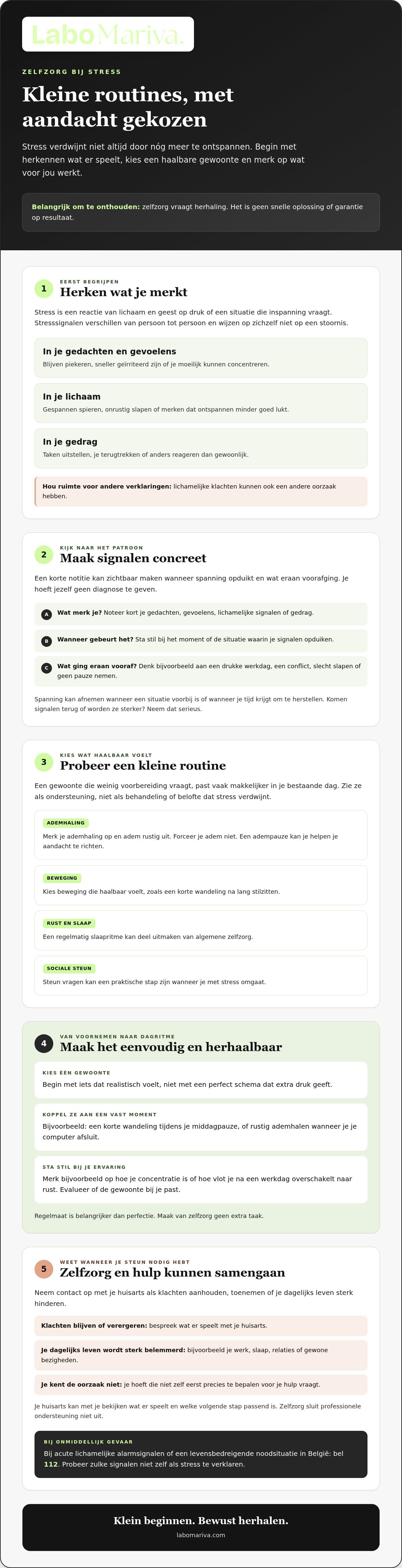
Make an achievable stress plan for your daily routine
A plan does not have to be a new daily schedule. Start small: try to get a sense of what triggers tension and find a habit that fits into your existing routine. This way, you can find out what feels supportive to you without expecting stress to disappear immediately.
How to start with a routine you can maintain
- Note what you notice. Briefly write down when tension arises and what preceded it. Think of a busy schedule, an interrupted break, or a difficult transition between work and home. Observe without judging yourself.
- Choose one small action. Take something that requires little preparation and fits into your day. For example, standing up after a long work block, trying a quiet evening routine, or talking to someone you know.
- Link the action to a fixed moment. Make the agreement concrete: after your lunch break, you go for a walk, or when you shut down your computer, you consciously take a step back from your work. A recognizable anchor point can make it easier to remember.
- Keep track of your experience. Note whether you carried out the action and how it felt to you. For example, pay attention to your concentration, relaxation, or sleep, without expecting a change as a matter of course.
How do you make room for relaxation and recovery?
Your routine can consist of a screen-free break, a short walk, a fixed rest moment before going to sleep, or contact with someone you trust. See sleep, movement, breaks, and support from your environment as possibilities, not as obligations. Relaxation is personal and doesn't always work as soon as you make time for it. If a chosen habit proves difficult to carry out, adjust it instead of blaming yourself for not maintaining it.
A busy period can interrupt your routine. That is information, not failure: make the action smaller, link it to a different moment, or choose an approach that better suits your day. If stress is mainly related to work, also look at your tasks, boundaries, and possibilities for recovery. If symptoms continue to weigh on you or increase, discuss that with your GP. Self-care can provide support, but does not have to replace appropriate help.
Would you like to view a supplement as a potential addition to your relaxation routine? Discover Unwind from Labo Mariva. A supplement is not a diagnosis or treatment and does not replace any care you need.
When extra support is advisable and what you can do next
Self-care can support your daily resilience, but you don't have to solve stress alone. Professional help and small habits can exist alongside each other. A conversation with your GP is a potential first step if symptoms persist, get worse, or strongly hinder your daily activities, for example, when working, sleeping, or taking care of yourself becomes increasingly difficult.
Which signals make professional help important?
Make an appointment with your GP when you notice that stress is no longer decreasing sufficiently, is limiting your functioning, or you keep getting stuck despite adjustments. You don't need to know the cause for certain first. It can help to briefly note in advance what symptoms you are experiencing, how long they have been occurring, and what you have already tried. This gives the GP a more concrete picture of what you need.
Take physical symptoms seriously and do not automatically attribute them to stress. In the case of acute alarm signals or immediate life danger, call 112 in Belgium. That is different from an appointment with your GP for symptoms that persist or make your life very difficult. Asking for help is not a sign that your self-care has failed. It is a way to look at what support is appropriate in a timely manner.
Can supplements be part of a self-care routine?
A supplement can at most be an optional addition. It does not replace sleep, achievable lifestyle habits, or advice from a healthcare provider, and is not a treatment for stress. Check the product information before use and discuss any questions with your GP or pharmacist, especially if you are taking medication, are pregnant, or are breastfeeding. Without verified product information, it is not wise to assume specific ingredients, dosages, or effects.
If you are considering an addition to your relaxation routine, you can view the information about Unwind gummies for relaxation. Assess that choice separately from medical care and follow the information on the label. A supplement offers no guarantee of less stress and does not replace appropriate help.
Therefore, the question of what to do about stress without therapy does not have to mean that you exclude help. Choose one achievable habit to try out and ask for support if symptoms continue to weigh on you. You may take both steps at the same time.
Choose one achievable step toward more rest today
What to do about stress without therapy? Start by recognizing when tension arises and choose one small habit that fits into your day. A short break, calm breathing, movement, or support from someone you trust can be a start. Then, look without judgment at whether the routine feels achievable and helpful. You don't have to change everything at once.
Self-care and professional support do not exclude each other. If your symptoms persist, increase, or make your daily life more difficult, discuss them with your GP. A supplement is at most a potential addition, not a treatment or replacement for appropriate care.
Labo Mariva is an independent Belgian laboratory, founded in 2021, with supplements such as Activate collagen shots, Unwind gummies, and a Combi Pack. Would you like to view the product information? Discover Unwind gummies for relaxation.
Choose one step that feels achievable today. Give yourself room to adjust and ask for help when you need it. Small, conscious choices can go hand-in-hand with the care that suits you.
Frequently Asked Questions
What can you do yourself about stress without therapy?
Start with one achievable step, such as a short break, calm breathing, or asking for support from someone you trust. The World Health Organization describes practical skills for coping with stress, including focusing attention on the present moment. That does not mean that one exercise works for everyone. Note what you try and how it feels to you. If symptoms persist or hinder your daily life, discuss that with your GP.
Can stress disappear on its own without professional help?
Stress associated with a temporary situation may decrease when that situation changes, but that process varies from person to person. You can give yourself time and space to recover while monitoring how you feel. The World Health Organization describes practical skills as a way to support you during stress, not as a guarantee that symptoms will disappear. If they persist, worsen, or limit your daily functioning, please contact your GP.
Which breathing exercise helps with stress?
There is no single breathing exercise that is proven to be the best choice for everyone. You can calmly observe your breathing and bring your attention back to the present moment, without breathing more deeply or slowly than feels comfortable. The World Health Organization's practical guide to managing stress contains exercises for attention and grounding. View such an exercise as a practice, not as a treatment or a guarantee of relaxation.
How long does it take for self-care for stress to have an effect?
There is no fixed timeframe in which self-care must have a noticeable effect. The experience depends, among other things, on the individual, the chosen habit, and the situation. Briefly keep track of whether you are following the routine and what you notice, for example regarding rest or concentration. The World Health Organization presents stress skills as something to practice, not as a promise of a specific outcome. Seek advice if symptoms persist or worsen.
Does walking help with stress?
A walk can be a practical break or a form of exercise, but it is not guaranteed to make you feel less stressed. The World Health Organization recommends regular physical activity for general health; that does not prove that walking in itself treats stress symptoms. Choose a pace and time that suit you. If physical activity does not feel feasible or your symptoms continue to weigh on you, discuss this with your GP.
When is stress too severe to handle on your own?
Contact your GP if symptoms persist, worsen, or significantly hinder daily activities such as working, sleeping, or taking care of yourself. You do not need to make a diagnosis yourself. In the event of an immediate life-threatening situation or an acute emergency, call 112 in Belgium, as stated on the official 112 website. For persistent stress symptoms, your GP is a possible first step. Self-care and professional support can go hand in hand.
Can supplements help with stress without therapy?
A supplement can at most be an optional addition to your routine. The information available on Unwind gummies provides no basis to name specific ingredients, dosages, or proven effects for stress. The European Food Safety Authority assesses scientific evidence for health claims regarding food and supplements, but that does not prove specific product effectiveness. Read the product information and seek advice from your GP or pharmacist. View the information on Unwind gummies.