

How clothing, personal care and gentleness can help boost your confidence
Your self-confidence doesn't grow by meeting a certain look, but by making choices that make you feel good. You can increase your self-confidence by consciously taking care of your appearance: wear clothes that fit comfortably, care for yourself gently, and attach less value to comparisons with others. This gives you a sense of stability without your self-worth depending on it.
It is understandable that an outfit, a grooming routine, or a comment about your appearance affects how you feel. At the same time, self-confidence is more than your appearance: your qualities, relationships, and the way you talk to yourself also count.
In this article, you will read how clothing and social comparison can color your self-image and how you can make grooming a moment of attention for yourself. You will also discover how to recognize self-criticism and replace it with a more realistic, kinder perspective. This way, you build up step by step an image that suits you and confidence that does not depend solely on the mirror.
Key takeaways
- Choose clothes that fit comfortably and suit your personality, so you can focus more on your day and less on insecurity.
- Notice when social comparison makes you insecure and bring your attention back to your own qualities and the people with whom you can be yourself.
- Make grooming a calm daily moment that aligns with what makes you feel good.
- Replace harsh self-criticism with a gentler, more realistic perspective and practice seeing your strengths too.
1. The influence of clothing on social interactions
Your outfit can help determine how you feel when you meet others. A well-fitting pair of trousers and comfortable shoes limit practical distractions, so your attention can go more to the conversation. In psychology, the concept of enclothed cognition describes how clothing can influence thoughts, feelings, and performance. A familiar outfit can, for example, help you focus on your message during a presentation.
Reactions from others can influence how you feel about clothing. A sincere compliment from a friend about your choice of color can be nice, while criticism about your body can evoke insecurity. Parents and peers play a role during childhood in how you learn to look at yourself and your appearance. Think of a child who is given space for their own style, versus a child who is laughed at for their clothes.
Beauty ideals influence what people find attractive or appropriate. Media often show carefully selected images, so you see a limited picture of beauty. If you take those images as the norm, the difference with your own appearance can fuel insecurity. Comparing your outfit with an edited photo online, for example, is not a comparison under equal circumstances. Choose media that feature different bodies, ages, and styles.
Color choices can have meaning in social situations, but associations are not fixed rules. Red is often associated with strength and energy, blue with calm and reliability. Yellow evokes associations with optimism, while black often radiates elegance. Wear blue to a presentation, for example, if that makes you feel comfortable, not because a color automatically gives confidence.
Try three things before an appointment: check if your clothes fit comfortably, match your outfit to the occasion, and ask yourself if you recognize yourself in it. This can limit distraction due to discomfort. Clothing supports your presentation, but does not determine your worth. In a conversation, listening, kindness, and interest in the other person also count.
Self-confidence takes shape early on: parents and peers play an important role in this. Social beauty ideals can also have an influence. Those who meet them may experience more confidence, while those who deviate from them can become insecure.
Clothing that gives you a sense of control or authority can make you feel more powerful and confident. If your outfit aligns with your personality, it can also support your sense of authenticity. This way, your choice gains meaning that goes beyond the impression you make on others.
2. Social comparison and wanting to fit in
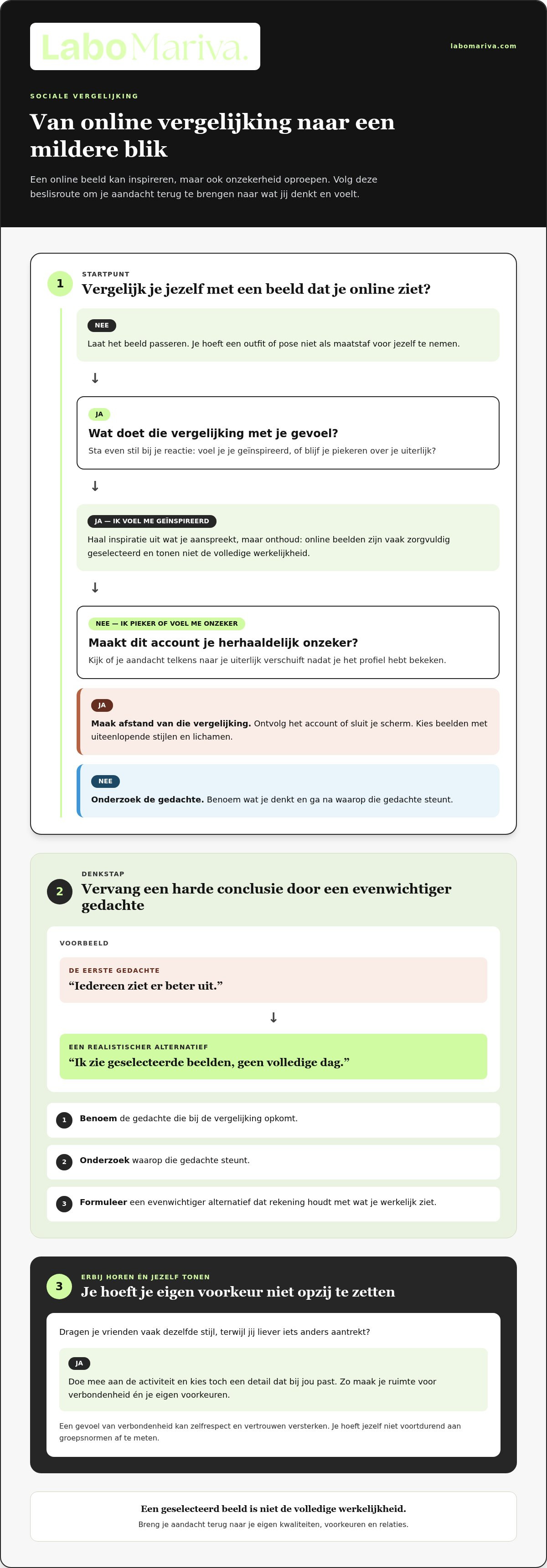
While scrolling on Instagram, your attention can shift to your appearance. You see, for example, a carefully chosen outfit or a pose that looks confident. Then you compare that image with yourself on an ordinary workday. Psychological research on social comparison describes how people assess themselves by using others as a reference. That comparison can inspire, but also evoke negative thoughts if you mistake a selected image for the complete reality.
Consciously notice how you feel after you have viewed a profile. Do you feel motivated, or do you keep worrying about your appearance? If an account repeatedly makes you insecure, you can unfollow it or close your screen. Choose images with diverse styles and bodies. That does not change your self-image immediately, but it does help you notice which beauty norms you see daily.
Fitting in and showing yourself do not have to exclude each other. Suppose friends wear the same clothing style, while you prefer to dress differently. You can participate in the activity and still choose a detail that suits you. This way, you make room for connection and your own preferences. Increasing self-confidence through appearance can start with not constantly measuring yourself against group norms.
Also research what you assess yourself on. After a conversation, write down what you contributed: you listened attentively, asked a good question, or made someone laugh. These are concrete qualities besides your appearance. Ask a friend with whom you can be yourself what they value about your connection. A sense of connection can strengthen self-respect and confidence.
After a moment of comparison, you can practice a simple thought step: name the thought, investigate what it is based on, and formulate a more balanced alternative. “Everyone looks better” can, for example, change into: “I see selected images, not a full day.” Increasing self-confidence through appearance does not mean you have to meet a norm. By consciously investigating your comparisons, you give yourself room to grow and accept yourself.
3. Grooming and presentation
You can support your self-confidence without changing your body or personality. Choose a grooming routine that suits you, such as washing your face, combing your hair, or dressing in clothes in which you can move freely. See those actions as personal preferences, not as treatment or obligation. This way, you pay attention to your presentation without expecting that a grooming routine will automatically solve insecurity.
A hairstyle, makeup, or beard care can influence how you present and recognize yourself. A hairstyle that you like to wear can, for example, fit your familiar style; with makeup you can place an accent that you find beautiful. Trimming your beard can align your image with your preference. Those choices change your appearance, but do not determine your worth. Choose them because they suit you, not because you have to match an ideal.
Affordable grooming in Belgium can easily start with things you already have at home. Wash your face with lukewarm water, use your own comb or brush, and keep your nails clean. First look at which products you already have and follow the instructions on the packaging. This way, you build up a calm routine without constantly buying something new.
Make your grooming practical for your day. Lay out an outfit the evening before and check if your shoes fit comfortably. If necessary, take a comb with you to touch up your hair on the go. For makeup, you can choose one familiar product; for beard care, your own trimmer can suffice. Repeatable steps keep your routine clear.
If you want to increase your self-confidence by paying attention to your appearance, start with a choice that feels good, not with the demand that you have to change yourself. Try one grooming action and notice how you feel about it. Changes in skin, hair, or body shape belong to different life phases. You may adapt your presentation and at the same time treat your body with respect.
Taking good care of yourself and feeling comfortable in your clothes can contribute to a more positive self-image. Being satisfied with your appearance can strengthen your self-confidence, regardless of what others think of it. You can accept external changes when getting older; at every age you can shine.
Eating healthy, moving, and sleeping enough are ways to take good care of yourself. Self-care can strengthen your self-worth and self-confidence because you consider your own needs important. During recovery, wearing nice clothes can support your emotional well-being and mood.
4. Self-criticism and perfectionism about appearance
A critical thought can sound like a fact, while it is only one interpretation. Think of: “My skin is not even, so everyone looks at it.” Ask yourself what evidence you have for that and what you would say to a friend. A more realistic answer can be: “I see a few spots, but they do not determine how others experience me.” This way, you investigate the thought instead of believing it immediately.
Perfectionism can make your appearance an endless project. You, for example, edit a photo every time, but then keep discovering new details. Try at such a moment to shift your attention to what your body does for you: your legs take you outside and your hands help you perform your daily tasks. That perspective does not deny your insecurity. Increasing self-confidence through appearance does not have to mean that you change every detail. It can help to develop a healthier body image, in which there is appreciation alongside criticism.
Practice with a small daily habit. Write down three positive qualities every evening, such as listening attentively, humor, or perseverance. In addition, name one thing about your appearance that you value, without comparing it with that of someone else. If you get a compliment, simply answer with “thank you” instead of immediately brushing it off. Repetition can help you notice positive information about yourself more consciously.
Insecurity about your appearance also deserves support. You can go to your GP, a psychotherapist, or a Center for Mental Health Care (CGG) with it. Discuss concrete situations, such as avoiding social appointments or constantly worrying in front of the mirror. A conversation can help recognize patterns and practice other ways to deal with criticism. Increasing self-confidence through appearance can also mean that you accept support when you need it.
Self-compassion does not mean that you have to find everything about yourself beautiful. It means that you talk to yourself as you would talk to a loved one: with respect, even on difficult days. Replace “I must change this immediately” with “I may learn step by step what helps me.” Gentleness can lower the pressure and give room to deal better with insecurity.
Labo Mariva: Activate (28 shots)
Labo Mariva offers Activate as collagen shots for those who also want to support external grooming from the inside. The package contains 28 shots. See this as a possible addition to your personal routine, not as a replacement for gentleness towards yourself, comfortable clothing, or daily self-care. A supplement does not change who you are and promises no fixed result.
If you want to pay attention to relaxation and sleep quality as well, there are Unwind (60 gummies) and the Combi Pack with Activate and Unwind. Choose what aligns with your well-being routine and view the product information to make a conscious choice.
Discover the Labo Mariva range online and read more about Activate.
Give yourself room to grow
Make your next step small and personal. Choose one grooming routine that feels pleasant, or write down which qualities you want to see more often in yourself. Notice what that choice does to you, without immediately passing a judgment. Increasing your self-confidence through attention to your appearance does not have to mean that you change yourself. It can also mean that you consciously choose how you take care of yourself and which thoughts you give your attention.
If insecurity continues to influence your daily life, feel free to seek support. Self-care and professional guidance do not exclude each other. A conversation can help better understand recurring thoughts and find achievable steps that suit you.
Want to discover what support Labo Mariva offers for your well-being routine? Contact Labo Mariva. Start where you are, choose what suits you, and give yourself the time to let confidence grow in your own way.